1. Why a Drone Strobe Light Changes Everything at Night
Thermal cameras find heat. Spotlights illuminate targets. But neither one tells a lost person that help has arrived. A strobe light does exactly that — and in night search and rescue, that psychological signal is often the difference between a successful extraction and a missed opportunity.
Here's a scenario that plays out in SAR operations worldwide: a DJI Matrice 350 RTK equipped with an H30T thermal camera detects a heat signature in dense forest at 2 a.m. The operator confirms it's human-sized. But the person is lying still — possibly unconscious, possibly asleep, possibly too exhausted to respond. How do you get their attention? A spotlight might startle them. A loudspeaker might not wake them. But a multi-color strobe pattern — flashing red, then blue, then white — creates a unmistakable visual signal from above. It says: "We see you. Help is coming. Stay where you are."
2. The Tactical Role of Strobe Lights in Night Operations
2.1 Signaling to the Victim: The Visual Rescue Beacon
The primary role of a drone-mounted strobe in SAR is not illumination — it's communication. When a lost hiker, a capsized boater, or an earthquake survivor looks up and sees a rhythmic pulse of colored light descending toward them, they instinctively respond: waving, shouting, moving into open ground. This behavioral trigger is well-documented in SAR after-action reports.
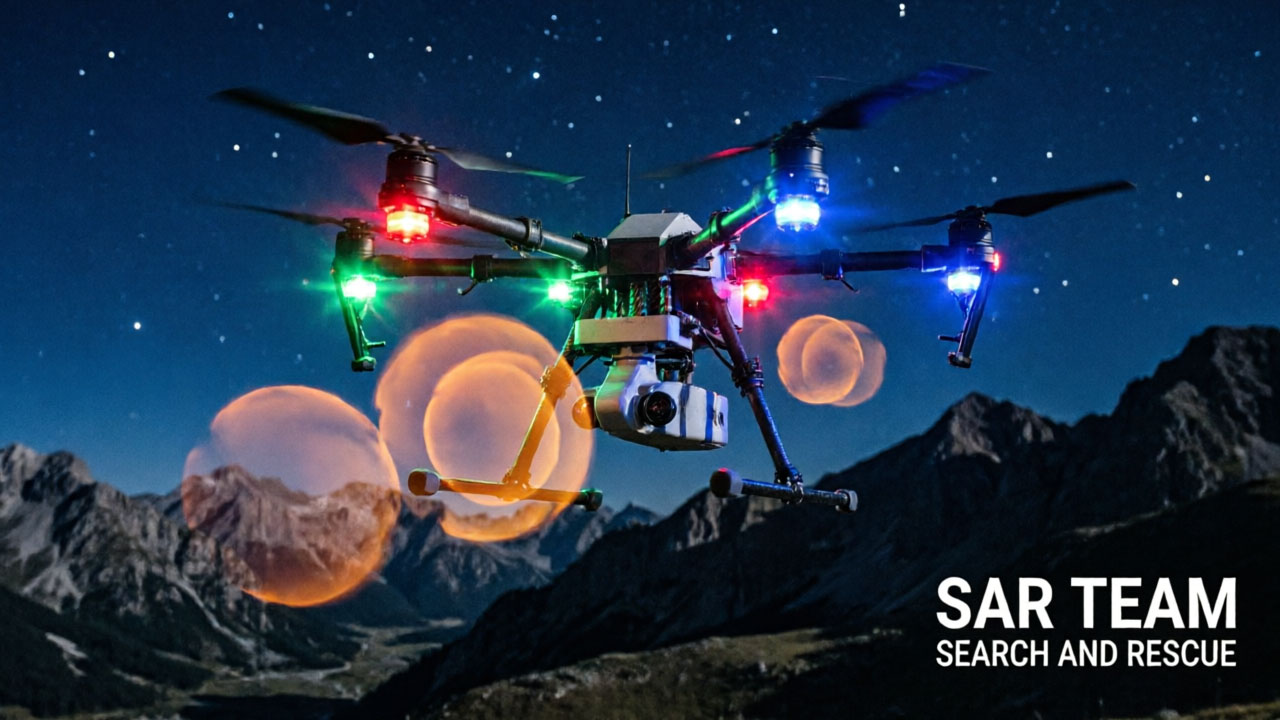
Multi-color RGB strobes are particularly effective because they can cycle through distinct colors with different psychological associations. Red signals emergency. Blue signals authority and reassurance. Green signals safety and direction. White maximizes visibility. A well-trained drone operator can use color switching to convey different messages without saying a word — critical when the victim doesn't speak the operator's language, or when radio communication is impossible.
2.2 Coordinating Ground Teams: The Airborne Signal Tower
In a typical night SAR mission, multiple ground teams fan out from a command post. Radio discipline is essential — but voice channels get saturated fast. A drone hovering at 100 meters with a strobe light becomes a visible reference point for every ground unit. Red pulse: "target acquired, stand by." Blue pulse: "ground team, proceed to coordinates." Green pulse: "area clear, return to base." This silent coordination protocol reduces radio congestion and speeds up decision-making.
On the DJI Matrice 30 series, the strobe light integrates through the PSDK E-Port and is fully controllable from DJI Pilot 2 — the same interface the operator already uses to control the camera gimbal and monitor telemetry. No second screen, no separate controller. One operator, one interface, full mission control.
2.3 Airspace Safety: See and Be Seen
Night SAR often involves multiple aircraft — police helicopters, medical evacuation, news choppers. A drone at 120 meters is invisible to a helicopter pilot scanning the ground with night vision. An FAA-compliant strobe visible at 1 kilometer ensures the drone is seen by other air traffic long before it becomes a collision risk. For operations near airports or in controlled airspace, this is not optional — it's a regulatory requirement.
3. Key Strobe Light Specifications for SAR Missions
3.1 Visibility Range: The 1-Kilometer Benchmark
The single most important specification for a SAR strobe is effective warning distance — how far away can a person or another aircraft see the flashing light? Professional-grade drone strobes achieve 1,000-meter visibility in clear conditions. This means:
- A ground team 500 meters away can identify the drone's position and bearing without radio guidance.
- A helicopter crew at 800 meters altitude can see and avoid the drone.
- A lost person in dense terrain can spot the light through tree canopy when the drone is directly overhead at 100 meters.
3.2 Multi-Color Capability: More Than Just Flash
A single-color strobe is a beacon. A multi-color strobe is a communication tool. Look for systems that support at least five independent colors — red, green, blue, yellow, and white — with user-definable flashing patterns and frequency adjustment. This allows the SAR operator to:
- Pre-program distinct color sequences for different mission phases (searching, target acquired, guiding ground team, extraction complete).
- Adapt to environmental conditions — yellow penetrates fog better than white; red stands out against snow; blue is visible against urban light pollution.
- Coordinate with color-coded ground team markers for seamless air-ground integration.
3.3 Weight: Every Gram Counts on a Fully-Loaded SAR Drone
A SAR-configured DJI Matrice 350 RTK typically carries a thermal camera (H30T, ~900g), a loudspeaker (~570g), and potentially a spotlight. Adding a strobe light to this payload stack requires careful weight budgeting:
- Ultra-light (under 70g): Single-unit strobes designed for DJI Dock 3 automated ops. Weighing just 65g with 24 RGB LEDs and DJI Pilot 2 / Flighthub 2 integration, they add negligible flight time penalty.
- Compact (100–150g): Multi-light strobe sets with four independent LED arrays. At 137g for a quad-light setup, they provide 360° coverage from a single mounting position on DJI M30 or M350 platforms via E-Port V2.
- Integrated audio-visual (under 30g): Combined strobe + high-decibel alarm units weighing just 23g — the ultimate lightweight signaling solution for Mavic 3 Enterprise or as a secondary payload on larger aircraft.
4. Real SAR Workflow: From Detection to Extraction
Here's a step-by-step operational workflow for a night SAR mission using a DJI enterprise drone with thermal camera and strobe light:
Phase 1: Wide-Area Search (Thermal Only, No Strobe)
The drone flies a grid pattern at 120 meters AGL. The thermal camera (DJI H30T or similar) scans for heat signatures. The strobe remains OFF during this phase to preserve battery and avoid drawing unnecessary attention. The operator monitors DJI Pilot 2 on the Smart Controller, looking for human-sized thermal anomalies.
Phase 2: Target Confirmation (Spotlight or Zoom Camera)
When a heat signature is detected, the operator descends to 60–80 meters and switches to the visual camera at maximum zoom. If ambient light is insufficient, a spotlight with a narrow beam (4°–8°) illuminates the target for positive visual identification. At this stage, the strobe is set to a slow blue pulse — visible enough for the ground team to orient toward, but not aggressive enough to alarm a potentially injured victim.
Phase 3: Victim Engagement (Strobe + Loudspeaker)
Once the target is confirmed as the search subject, the operator activates the full strobe sequence: alternating red and white pulses at medium frequency. Simultaneously, a pre-recorded TTS message plays through the loudspeaker in the local language: "Rescue team has located you. Please stay where you are. Help is arriving." The synchronized audio-visual signal eliminates ambiguity — the person knows they've been found.
Phase 4: Ground Team Guidance (Color-Coded Navigation)
The drone maintains position above the victim while the strobe switches to a steady green pulse. Ground teams navigate toward the green beacon — visible through forest canopy and over rough terrain up to 500 meters away. The drone operator relays GPS coordinates to ground units via radio while the strobe provides a visual confirmation of the correct approach vector.
Phase 5: Extraction and Airspace Deconfliction
As the ground team reaches the victim, the strobe switches to alternating red/blue at maximum intensity — signaling to any incoming medevac helicopter that a drone is on station. This is the critical airspace safety phase. The 1-kilometer visibility of professional strobes ensures the helicopter pilot sees the drone's position from a safe distance, even without direct radio contact between the drone operator and the aircraft crew.
5. DJI Platform-Specific Strobe Configurations
5.1 DJI Matrice 350 RTK — The Full SAR Loadout
The M350 RTK's dual gimbal ports and 2.7kg payload capacity allow the most complete SAR configuration: H30T thermal/zoom camera on the primary gimbal, loudspeaker on the secondary port, and a quad-light strobe set mounted via the E-Port V2 on the auxiliary bracket. This triple-payload setup covers detection (thermal), communication (speaker), and signaling (strobe) — all controllable from a single DJI Pilot 2 interface. Total payload weight: approximately 1.6kg, leaving ample margin for the 2.7kg budget.
5.2 DJI Matrice 30 Series — Rapid Deployment SAR
The M30's compact form factor and quick-deploy design make it ideal for time-critical SAR where every minute counts. A single integrated strobe unit (65g, E-Port Lite) adds virtually no setup time. Paired with the built-in thermal camera and laser rangefinder, the M30 becomes a self-contained night SAR platform that can be airborne in under two minutes from vehicle to flight.
5.3 DJI Dock 3 — Automated Night Patrol
For persistent SAR coverage — such as monitoring flood zones, wildfire perimeters, or maritime search areas — a DJI Dock 3 with a strobe-equipped drone enables automated night patrols. The drone launches on schedule, flies a pre-programmed route, and the strobe serves as both a navigational beacon for ground units and a warning light for other aircraft. DJI Flighthub 2 provides remote mission control with real-time strobe status and color selection. The 65g ultra-light strobe is purpose-built for this automated workflow.
6. Best Practices for SAR Strobe Operations
- Battery management: Strobe lights typically consume 10–25W. On a 30-minute SAR flight, factor approximately 3–5% battery reserve for strobe operation. Plan your mission accordingly.
- Color protocol standardization: Establish and train your team on a consistent color code before deployment. Changing protocols mid-mission causes confusion.
- Test visibility from the victim's perspective: During training, place a team member at the expected search distance and altitude. Verify they can see and interpret each strobe color. What looks obvious from 120 meters up may be ambiguous from the ground.
- Coordinate with local aviation authorities: In controlled airspace, file a NOTAM or coordinate with ATC before conducting night strobe operations. A 1km-visible strobe is an aviation light — treat it accordingly.
- Post-mission debrief: Review strobe usage in after-action reports. Which colors worked best? What frequency was most visible? Feed this data back into your team's SOP for continuous improvement.
7. Conclusion: The Strobe Light Is a SAR Force Multiplier
A drone without a strobe is a silent observer. With a strobe, it becomes a command-and-control node in the sky — directing victims, guiding rescuers, and protecting airspace. The investment is minimal — a 65g device that costs a fraction of a thermal camera — but the operational impact is enormous. In night search and rescue, where every second counts and every signal matters, a properly deployed strobe light system can mean the difference between finding someone alive and not finding them at all.
Equipping your SAR drone fleet with mission-specific strobe lights? Contact us for a configuration recommendation based on your aircraft platforms and operational requirements.